SIDE, DOWN, CLEARVU'....???

ALL-IN-ONE CHIRP TRANSDUCERS
Chirp, Down Vision, Side Vision features

In the previous article we talked about CHIRP transducers, the transducers we defined as ALL IN ONE.
I must honestly admit that all the brands interested in building transducers and instruments with these features have not helped to clarify the doubts about these characteristics, this due to disputes between them which it is not worth getting into.
As far as we're concerned, this article aims to clarify and make things as simple as possible for you when it comes to choosing the right fish finder.
Below you will find summary images that differentiate the two features that we define as Down Vision and Side Vision, based on the products of the various brands.


Down Vision

HUMMINBIRD indicates it as DOWN IMAGING abbreviated to DI, lately changed to MEGA DI
(thanks to the new 1.200khz frequency)
GARMIN initially as DOWNVU' then converted to CLEARVU'
RAYMARINE generically DOWN VISION
LOWRANCE and SIMRAD instead DOWNSCAN


Side Vision

HUMMINBIRD indicates it as SIDE IMAGING abbreviated to SI, lately become MEGA SI
(thanks to the new 1.200khz frequency)
GARMIN and RAYMARINE both identify it as SIDE VISION
LOWRANCE and SIMRAD instead SIDESCAN


Once we have distinguished the different definitions based on the brands, let's try to better understand what it is.
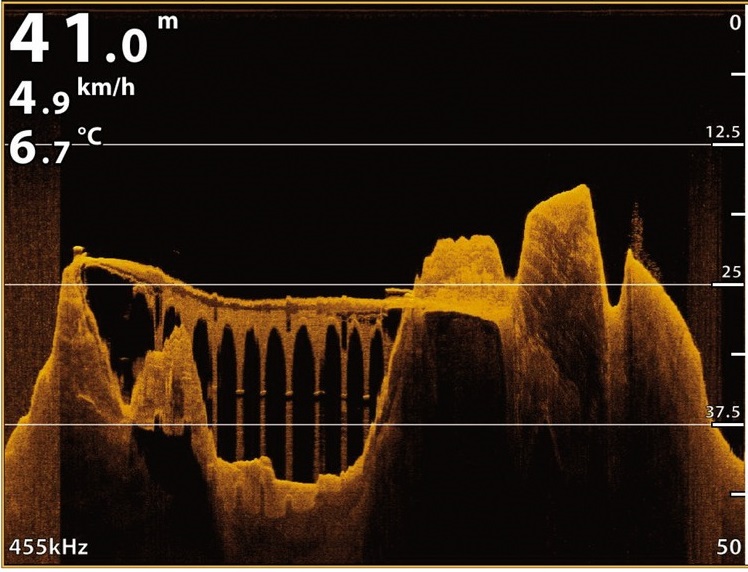
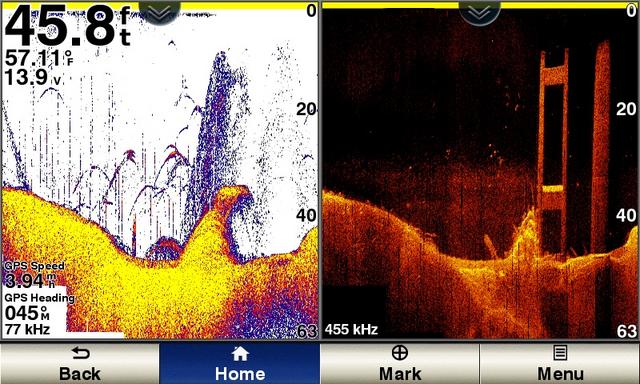
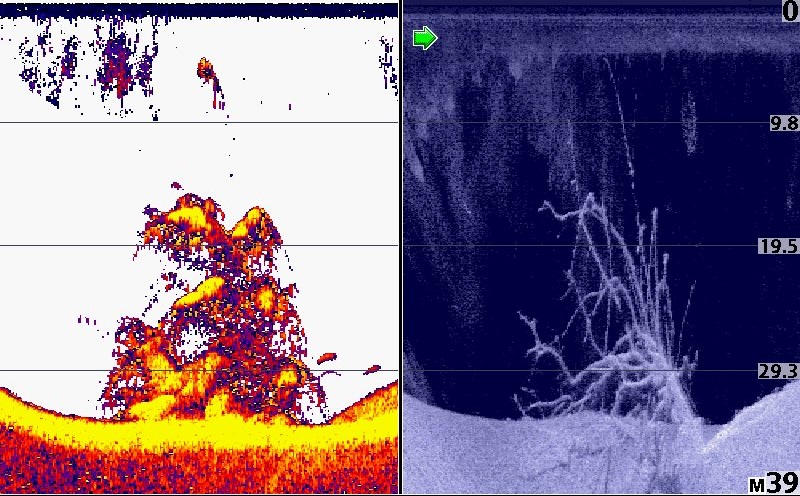
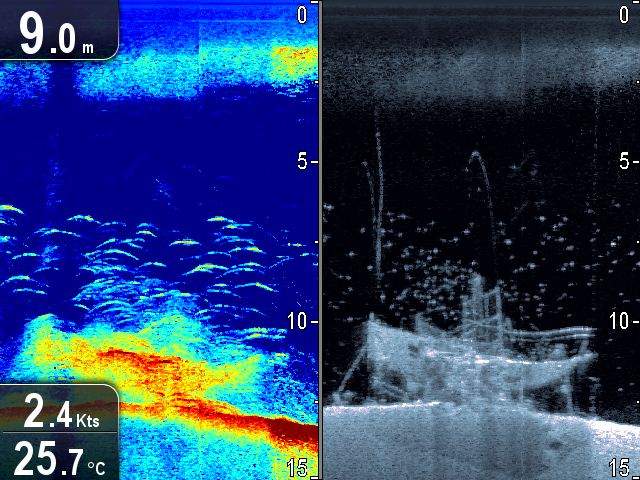
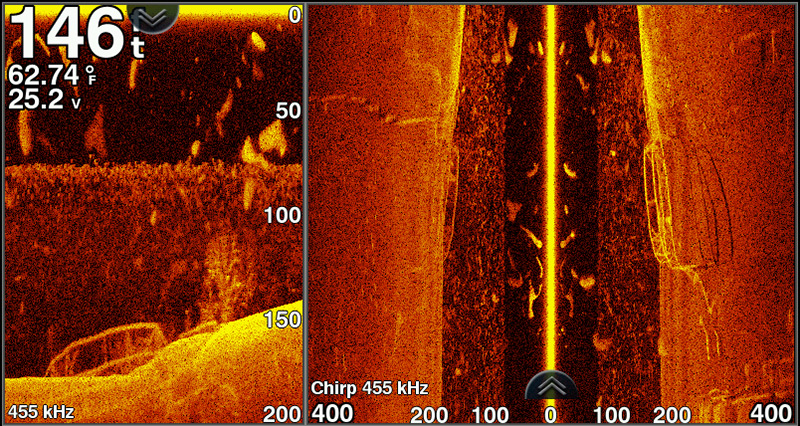
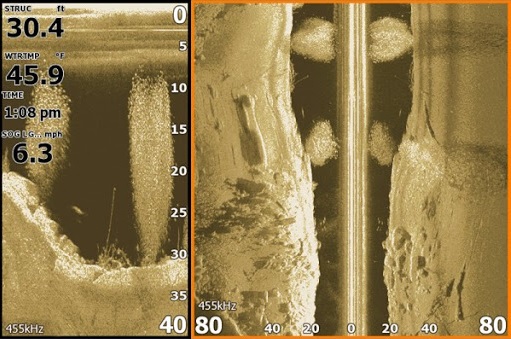
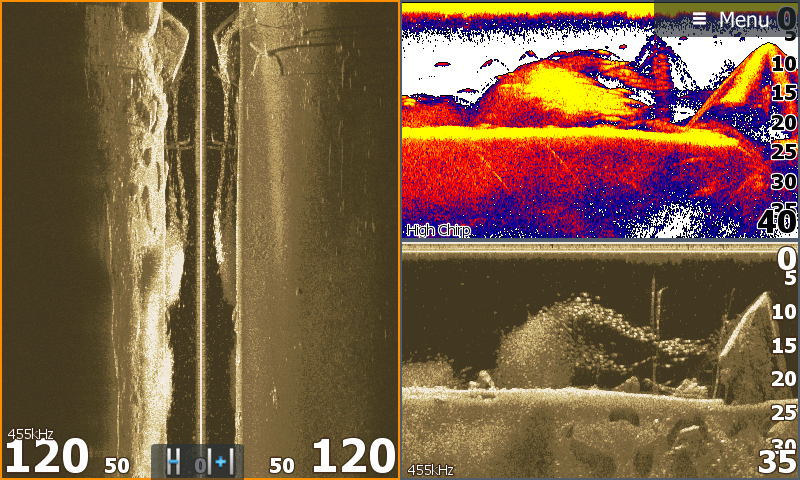
The Down function, thanks to the new Chirp technology and the use of the very high frequencies of the new transducers (455-800-1200 kHz), allows you to obtain very high-definition images of what we find on the seabed BELOW (hence the name DOWN) our vessel. Be careful, because this function is not suitable for seeing fish, but rather for better discriminating if we are in the presence of algae, rocks, wrecks, etc.; we always leave the classic 2D view of fish.
The images below perfectly clarify the fundamental aspects of the DOWN function.


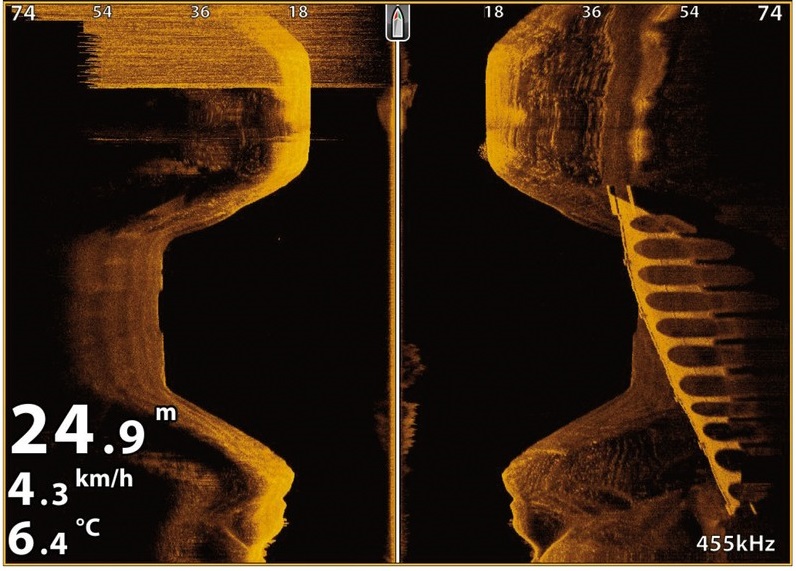
The Side function allows you to see the seabed from a different perspective, namely the SIDE one.
You will then be able to see what is underneath your boat to the right and left, always referring to large targets, not fish, except for a few rare exceptions as you can see in the second image.


However, a clarification is necessary on this aspect: we must always keep in mind that the quality of certain images is influenced especially if we are in the presence of fresh water and if very high frequencies, up to 1200 kHz, are used.
The performance of the Down and Side functions in salt water is significantly influenced by the salinity and the more or less turbidity of the water, sometimes it is necessary to obtain good results, lower the frequencies, therefore using 455khz or if the transducer allows it also 260khz.
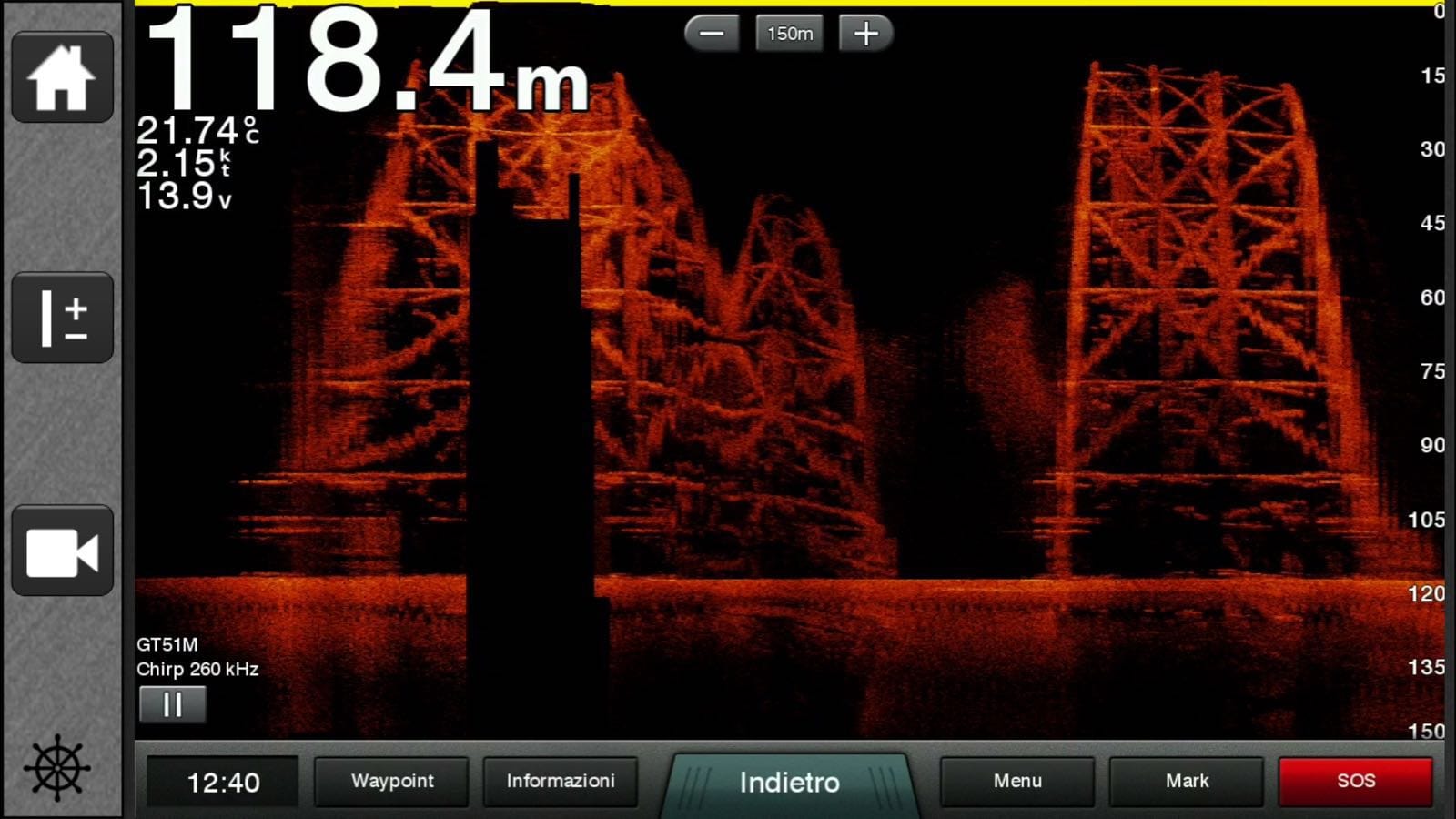
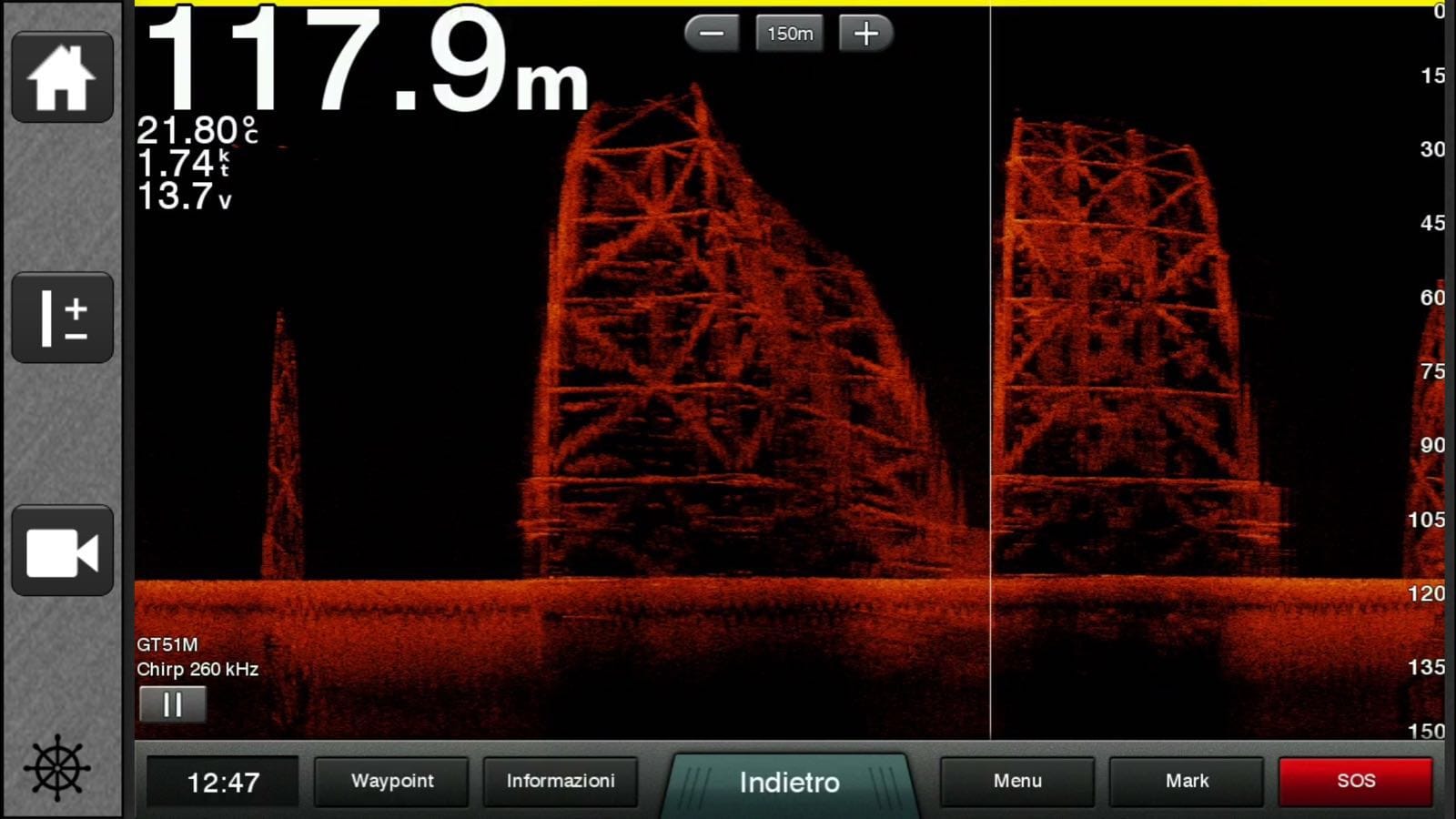
Performance at deepest depths is also significantly influenced by frequencies, so the higher the frequency, the shallower the depth; the lower the frequency, the better it can reach greater depths. From our findings, we can say that with 1200kHz, you can approximately reach a maximum of 20-30m, with 800kHz we are around 40-50m, with 455kHz about 60-80m and finally with 260kHz, you can even reach over 100m. Among the best ALL-IN-ONE transducers that can reach 100m is definitely the Garmin GT51.


These images were kindly provided to us in
exclusive from one of our customers who owns a
Garmin 7410xsv with GT51 through


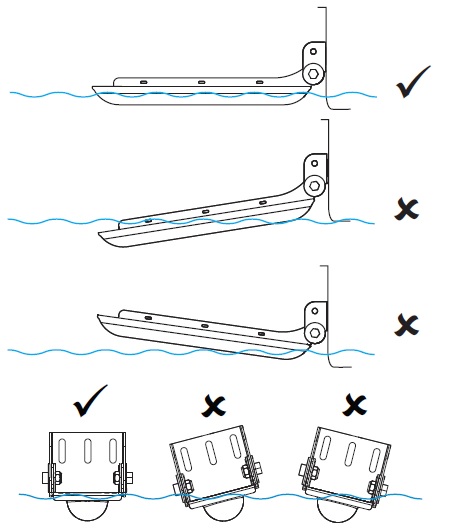
INSTALLATION OF TRANSDUCERS
 
We want to give important emphasis to the installation of these transducers, especially the through-beam ones.
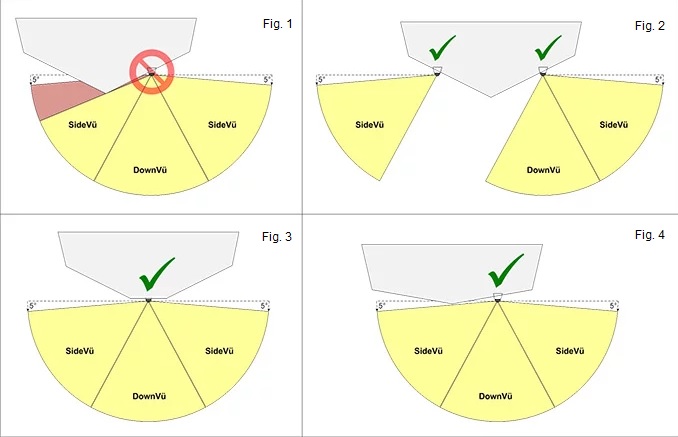
Below are some correct or incorrect images of the transducer mounting with Side Vision.


BE CAREFUL when mounting through-beam transducers.

Figure 1 illustrates an absolutely wrong way of installing a
transducer with Side Vision.
It is perfectly noticeable that you will have on the echo screen, the left part for
half in shadow, this also translates into major problems of disturbances
on the correct reading of the seabed.
It is therefore necessary, figure 2, to foresee the installation of the pair of transducers,
one for the left side and one for the right side, it is wrong to buy two transducers and not
the couple, because in the latter the Splitter cable is provided which excludes the part
of the transducer in shadow.
In figures 3 and 4, however, two correct installations, even though the transducer is
installed on its side, figure 4, it is important that the extreme part of the transducer,
always remain lower than the extreme point of the keel.


Gallery
Send comments
No comment
Our strength: complete and reliable solutions.
Design
Design

Clear diagrams for easy installation.

Consulting
Consulting

Equipment suited to your needs.

Realization
Realization

High quality systems.

Do you need help?
Do you need help?

Guaranteed after-sales support.

Don't lose your way!
Subscribe to our free newsletter.
REGISTER
REGISTER